
Mobile App Development Company in Kuwait: The Honest Buyer's Guide
TL;DR
Every mobile app development company in Kuwait pitches the same thing: 350+ projects, 100+ clients, full-stack expertise. None of that tells you whether they'll ship your app on time without bleeding the budget. This guide is the questionnaire I'd run if I were the buyer — what to ask, what to ignore, and how to spot the agencies that quietly outsource everything to Upwork.
Every mobile app development company in Kuwait sounds the same.
350+ projects delivered. 100+ happy clients. AWS partner. Full-stack expertise across iOS, Android, React Native, Flutter, Ionic, Xamarin, and probably PhoneGap if anyone still remembers what that is. Agile, transparent, end-to-end, blah blah.
I've sat through enough of these pitches to write them myself. The problem isn't that the claims are lies — most of them are technically true. The problem is that none of them tell you what you actually need to know before signing a KWD 15,000 contract.
This is the guide I wish founders had before they walked into those meetings.
The questions that actually filter agencies
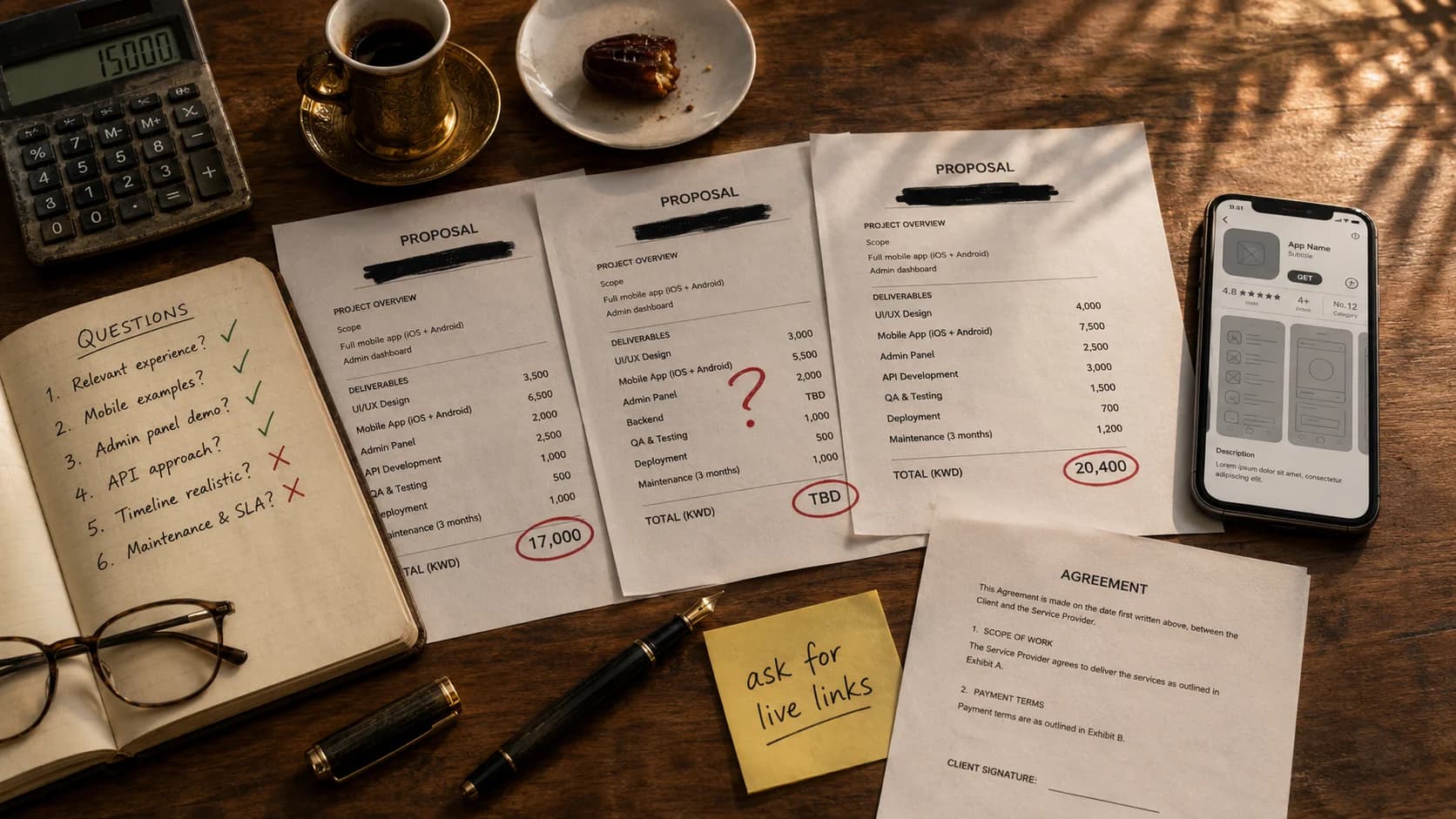
When a client asks me how to vet an app dev shop, I give them this list. It's six questions. The agencies that answer cleanly are usually the ones that ship cleanly. The ones that dodge — well, you've already learned what you needed to know.
1. "Show me three apps you shipped in the last 12 months — App Store and Play Store links, please."
Not screenshots. Not case studies. Live, downloadable links.
You'd be amazed how many "leading mobile app development companies in Kuwait" can't produce three current live links. Their portfolios are heavy on mockups, light on shipped products. Some of those projects were dropped mid-build, some are stuck in review hell, some only exist as APK side-loads on the founder's phone.
If they can't show three live, current apps — they don't ship as often as the homepage claims.
2. "Who is actually going to write my code? Names, please."
This is the question that separates real agencies from sales fronts.
Some Kuwait-based shops have a ten-person sales team, two project managers, and a Slack channel of freelancers in Lahore and Cairo who do the actual building. That's not inherently bad — half the world ships software this way — but you should know it before you sign, because:
- You're paying agency margin on contractor work
- The "agile process" is really three time zones playing email tag
- If the contractor flakes, you're stuck
Ask for the LinkedIn profiles of the lead developer and lead designer who'll be on your project. If the answer gets fuzzy, you've found the front.
3. "What's the backend quote? Itemise it separately."
Most app pitches price the iOS and Android build at KWD 12,000 and the backend at "to be discussed." That's a giant red flag.
Mobile apps are 30% mobile, 70% backend. The backend is where authentication, payments, push notifications, real-time sync, file storage, admin tools, and your entire data model live. It's also where 60% of post-launch bugs hide. Any agency that won't itemise it upfront is either:
- Hoping to upsell you mid-build, or
- Hasn't actually thought about your data model yet
Both answers are bad. We unpacked the trade-offs between custom backends and BaaS in Edge Computing for Web Apps: Why Latency Matters in the GCC — same logic applies to mobile.
4. "Why this stack and not the other one?"
Watch the answer carefully.
A good answer references your features: "You need offline mode and biometric auth, both of which work cleanly in React Native, plus you want to ship to both stores fast — so cross-platform makes sense here."
A bad answer references the agency's preferences: "We use Flutter because it's the latest and greatest, very robust, very scalable."
The first is consultative. The second is whatever-they-already-know-how-to-build dressed up in marketing words. We broke down the real differences in Mobile App Stack: React Native, Flutter, or Native.
5. "What's your post-launch support look like — and what does it cost?"
The build is roughly half of what you'll spend on this app over its first 18 months.
Apps need updates. iOS releases a new SDK in September every year and breaks something. Android does the same in autumn. Apple changes review rules quarterly. If your dev team disappears two weeks after launch — you're in trouble.
Get the support agreement on paper before signing. Real numbers I've seen from credible Kuwait shops:
- → Bug fix retainer: KWD 300–800/month
- → Feature development: KWD 60–120/hour
- → Major version updates: scoped per release
- → Critical hotfix SLA: 24–48 hours
If they're handwaving on this, you're going to be paying emergency rates the first time iOS 19 ships.
6. "Do I own the code?"
Always ask. Get it in writing.
Some agencies retain partial ownership of the codebase, claim shared IP on "framework components" they wrote for you, or refuse to hand over the GitHub repo until invoices clear plus 60 days. That's leverage, and it's the kind of leverage that bites you when you decide to switch teams.
The clean answer: "You own 100% of the code. We hand over the repo and the App Store / Play Store credentials at launch." Anything fuzzier than that — negotiate it now, not later.
What to actually expect to pay (real numbers)
Stripping out the marketing spin, here's what real projects cost in Kuwait in 2026:
| Project type | Realistic budget (KWD) | Timeline |
|---|---|---|
| Template wrap (don't ship as production) | 1,500 – 3,000 | 2–4 weeks |
| Cross-platform MVP (1 user role, 5–8 screens) | 8,000 – 15,000 | 10–14 weeks |
| Full SaaS / marketplace app | 18,000 – 35,000 | 4–6 months |
| Fintech / e-commerce with payments | 25,000 – 60,000+ | 5–8 months |
| Native iOS + Android (separate codebases) | 1.6× – 2× the cross-platform price | +30–50% time |
Anything quoted dramatically below these ranges is either a junior team underbidding to build a portfolio, or a shop that's about to hit you with change orders six weeks in.
When you should NOT hire an app development company
This is the contrarian part most agencies will never tell you.
If your product:
- Doesn't need push notifications, offline mode, biometrics, or location services
- Will be used mostly from a desk
- Hasn't been validated with paying users yet
Then you don't need a mobile app yet. You need a responsive web app or PWA. Build that for a third of the cost, get real usage data, and then spend the KWD 15,000 on mobile when the data demands it. We covered the full decision tree in Web vs Mobile Applications: Key Differences and How to Choose.
The 4-week trial trick
Here's something I've seen work for founders who've been burned before.
Instead of signing a 6-month contract upfront, scope a 4-week paid pilot. Pay the agency to deliver:
- Discovery and locked feature list
- Full design system and clickable prototype
- Backend architecture document
- Detailed build estimate with milestones
Total cost: usually KWD 1,500–3,500. At the end of week four you have:
- A real artifact you can take to any dev team
- A clear sense of how this team thinks, communicates, and ships
- Zero lock-in
If they're great — sign the build phase. If they're shaky — you walk with the artifact and you've spent 5% of the project budget instead of 100%.
This single move has saved more clients than any other piece of advice I give.
What to do now
If you're talking to a mobile app development company in Kuwait this week:
- Send them the six questions above. Verbatim. Watch how they respond.
- Ask for three live App Store/Play Store links from the last 12 months.
- Get the backend quoted separately and itemised.
- Propose a 4-week paid pilot before any long-term contract.
- Confirm in writing that you own 100% of the code and the store credentials.
Pick the shop that answers cleanly on all five. Walk away from the rest, no matter how impressive the homepage.
If you want a second pair of eyes on a quote — or a straight answer on whether you actually need a mobile app at all — that's literally the conversation we have with founders every week. Talk to our team before you sign. The 30-minute call costs you nothing and could save you tens of thousands.
Frequently Asked Questions
How much does mobile app development cost in Kuwait in 2026?
A real, production-ready mobile app in Kuwait typically costs between KWD 8,000 and KWD 60,000 depending on scope. A simple cross-platform MVP with auth, a few screens, and one payment integration sits around KWD 8,000–15,000. Marketplace, fintech, or apps with custom hardware usually run KWD 25,000–60,000+. Agencies quoting under KWD 2,500 are almost always reselling templates — fine for a prototype, dangerous for production.
What should I ask a mobile app development company before hiring them?
Ask for three things: a list of apps they've shipped to the App Store and Play Store in the last 12 months (with live links), the names of the people who will actually code your app (not the salesperson), and a separately scoped backend quote. If any of those three are vague — walk away. The agencies that ship cleanly answer all three in writing without flinching.
How long does it take to build a mobile app in Kuwait?
A focused MVP from a credible Kuwait-based agency takes 10–16 weeks from kickoff to App Store and Play Store approval. That includes discovery, design, build, QA, and store submission. A full marketplace or fintech app with payments, multi-role permissions, and admin dashboards usually runs 5–7 months. Apple's review process alone can add 1–2 weeks if your team trips over a guideline.
React Native, Flutter, or native iOS and Android — which should I pick?
For most business apps in Kuwait — booking, e-commerce, marketplaces, internal tools, SaaS — React Native or Flutter is the right call. One codebase ships to both stores at roughly half the cost. Go fully native (Swift, Kotlin) only when you need AR, heavy camera processing, deep Bluetooth, or graphics-intensive gaming. Picking the stack should follow the feature list, not the other way around.
What are the red flags when hiring a mobile app development company?
Three big ones: (1) refusing to name the actual developers who will write the code, (2) bundling the backend cost into a vague "TBD" line item, and (3) showing only mockups in their portfolio instead of live App Store links. Also watch for agencies that pitch a stack before they've heard your features — that means they're selling whatever they already know how to build.
Explore Our Services
- Best digital marketing agency in Kuwait
- google business view Kuwait
- google ads agency Kuwait
- seo agency in Kuwait
- mobile app development Kuwait
- web design agency Kuwait
- google reviews management Kuwait
- commercial photography Kuwait
- commercial video production Kuwait
- social media scheduling tool kuwait
- goai business analytics Kuwait
- social media marketing Kuwait